
AI-driven search is reshaping how users find information online. Instead of simply listing links, modern search engines prioritize answers that feel natural, concise, and contextually relevant. This shift means traditional SEO alone isn’t enough. To thrive, businesses need AEO — Answer Engine Optimization.
AEO focuses on structuring content so AI can understand it and present it as a clear, useful answer to user queries. For local service businesses, this approach can drive visibility in AI-generated search results, attract clicks, and connect directly with potential customers.
Understanding AI Search
AI search combines traditional search algorithms with advanced language models. These systems don’t just match keywords; they interpret intent, context, and related topics to generate accurate, human-like answers.
For example, someone looking for “emergency plumbing services in Denton” might see an AI snippet summarizing trusted providers, including local business details and contact information. This approach makes clarity, relevance, and structured content essential.
AI search emphasizes:
-
Context over keywords: Phrasing and semantic relationships matter more than exact matches.
-
Answer quality: Clear, concise, and factual responses rank better.
-
Structured content: Content that’s organized into questions, answers, and step-by-step guides is easier for AI to interpret.
How AEO Differs from Traditional SEO
Traditional SEO focuses on ranking pages based on keywords, backlinks, and on-page factors. AEO shifts the focus toward providing clear answers, integrating local context, and signaling relevance through structured data.
Differences include:
-
Content format: AI prefers Q&A, bullet points, numbered steps, and concise explanations.
-
Semantic understanding: AI looks for related topics and context, not just exact phrases.
-
Local signals: Geographic context embedded naturally within content improves visibility without forced phrases like “near me.”
AEO ensures your content doesn’t just appear in search results but is presented directly as an AI-generated answer.
Structuring Content for AI Visibility
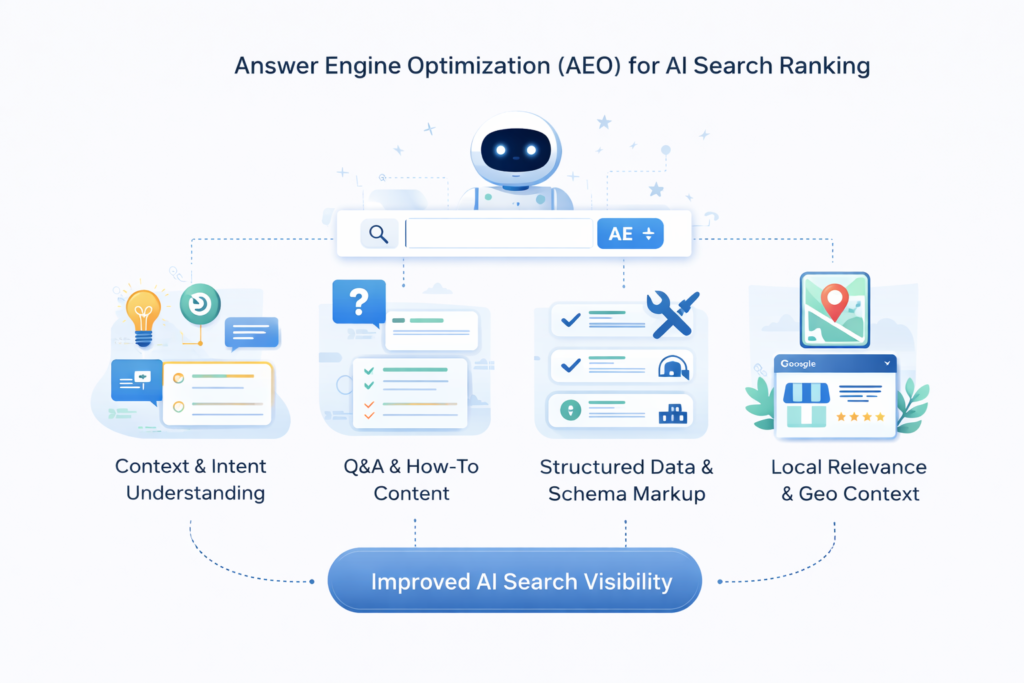
Content needs a logical flow and easy-to-understand structure. This involves:
Clear Headings
Use headings that answer common questions or explain services. Examples:
-
What is AI search?
-
How does AEO improve your visibility?
-
Local service tips for AI ranking
Headings help AI parse content and match user queries effectively.
Natural Question-and-Answer Sections
AI favors content that provides direct answers. For instance:
Q: How can I optimize my plumbing service for AI search?
A: Provide clear, factual service descriptions, include location references, use bullet points for key features, and add structured FAQ markup.
Semantic and Related Keywords
Rather than stuffing keywords, include related phrases naturally. For example:
-
Local service visibility
-
Semantic SEO
-
AI-friendly content
These terms create a topical network that AI can recognize, increasing your chances of appearing in relevant answers.
Step-by-Step or How-To Content
Short, actionable steps help AI extract information for featured snippets. For example, a guide on “Scheduling a plumbing service” could be structured as:
-
Check service availability online.
-
Call or submit a service request form.
-
Confirm appointment details.
Even simple procedural content can boost snippet visibility.
Using Structured Data
Structured data tells AI exactly what your content represents. JSON-LD schema types like FAQ, HowTo, and Service schema make content more understandable.
-
FAQ schema: Highlights common questions and answers.
-
HowTo schema: Provides step-by-step instructions.
-
Service schema: Clarifies offerings, locations, and contact info for local relevance.
For local businesses, including addresses, service areas, hours, and reviews signals credibility and geographic relevance to AI.
Local Context and Geo Relevance
AI can infer local relevance without explicit “near me” phrases. Strategies include:
-
Mentioning city or neighborhood naturally in service descriptions.
-
Linking to local events or regional resources.
-
Incorporating reviews and testimonials with geographic references.
Google Business Profile integration is essential. Accurate listings improve AI recognition and support citations for better visibility in local AI search results.
Semantic and Topical SEO
AI values content that covers a topic comprehensively without overloading keywords. Using semantic and topical SEO techniques ensures coverage of related themes.
-
Include synonyms and contextually related terms naturally.
-
Use content clusters to cover related subjects, e.g., AI content optimization, AI ranking factors, AI SEO strategies.
-
Include multimedia elements such as images with descriptive alt text, infographics, and transcripts for videos.
Semantic SEO supports both human readability and AI comprehension, helping content appear in more diverse answer snippets.
Content Formats AI Prefers
AI algorithms favor content that is structured, scannable, and easy to digest. Preferred formats include:
-
FAQs and Q&A pages
-
Short guides or procedural articles
-
Summarized bullet points for key information
-
Visual content with captions and alt text
Combining these formats enhances engagement and encourages higher CTR, as users are more likely to click results that feel complete and helpful at first glance.
Monitoring AI Performance
Tracking visibility in AI search requires specialized metrics:
-
Check which queries generate AI snippets that include your content.
-
Analyze click-through rates for AI-powered listings.
-
Adjust content based on performance signals, updating answers for clarity or completeness.
Regular monitoring ensures content remains relevant, accurate, and aligned with evolving AI search behavior.
AEO Agency helps businesses implement AEO and semantic SEO strategies to improve AI visibility and local search performance. Services include structured content creation, FAQ and HowTo schema implementation, and semantic keyword optimization.
Conclusion
AI search is rapidly changing how users find and interact with content. By focusing on clear, structured answers, local context, semantic relevance, and proper schema markup, businesses can improve their chances of appearing in AI-generated results. For service-based businesses, this means reaching potential customers more effectively and increasing engagement through higher CTR.
AEO strategies, combined with local relevance and semantic SEO, are no longer optional — they are essential for maintaining visibility in modern AI search results. Implementing these techniques can give businesses a measurable advantage, helping them stand out where traditional SEO alone may fall short.