
If you search “answer engine optimization” right now, you’ll find plenty of articles that explain what it is. What you won’t find as easily is someone walking you through exactly how to do it, the actual workflow, the decisions you make along the way, and what to look at when things aren’t working.
That’s what this guide is.
This is not a definition piece. If you’re here, you already know what AEO is. You want to know how to actually do it, in the right order, without wasting time on things that don’t move the needle.
So let’s get into it.
What AEO Is and Why the Process Looks Different from Traditional SEO Strategy
Before we start building anything, it helps to understand one key thing: AEO is not SEO with a different coat of paint. The goal is different, and that changes everything about how you approach it.
With traditional SEO, you’re trying to rank a page so people click on it. The metric that matters most is position on a results page. With answer engine optimization, you’re trying to get an AI system like Google’s AI Overviews, ChatGPT, Perplexity, or Claude to pull your content and use it as part of its response to someone’s question. There may be no click at all. Your content appears as the answer.
That shift in goal means the process has to start differently. You’re not asking, “What keyword can I rank for?” You’re asking, “What questions are people asking AI, and is my content structured so that an AI can read it, trust it, and quote it?”
The order of operations matters here. A lot of people jump straight to schema markup or start rewriting pages without first understanding what prompts their target audience is actually typing. That’s backwards. You end up optimizing for the wrong questions.
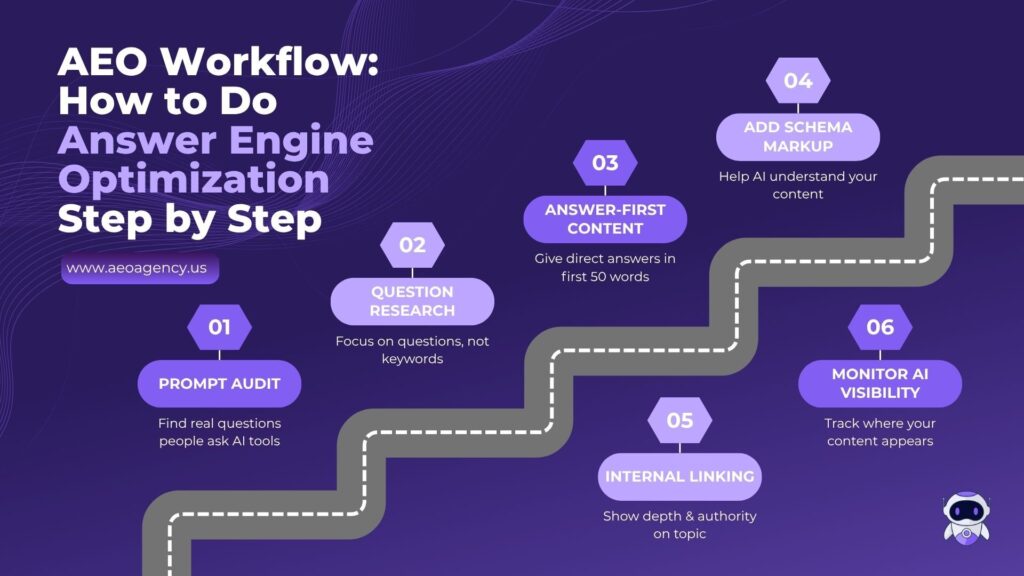
The correct sequence looks like this:
- Run a prompt audit to find the actual questions being asked
- Map those questions to your content gaps and opportunities
- Restructure existing content to lead with direct answers
- Add schema markup that helps AI parse your page correctly
- Build internal links that signal you cover a topic in depth
- Set up monitoring so you can see when it’s working
Each of these steps matters. And skipping one tends to undermine the ones that come after it.
Step 1: Run a Prompt Audit Before You Touch a Single Page (AEO Audit for AI Search)
A prompt audit is exactly what it sounds like: you go find the questions people are asking AI tools about topics related to your business, and you document them before you do anything else.
This is the single most skipped step in AEO, and it’s the one that determines whether everything else you do actually hits the right targets.
How to run one:
Start with the AI tools your audience is most likely to use. For most business categories, that’s Google AI Overviews, Perplexity, and ChatGPT. Open each one and start typing questions as if you were a potential customer who had never heard of your brand.
For example, if you run an AEO agency, you might type:
- “How do I get my business to show up in AI answers?”
- “What is the best way to optimize for ChatGPT search?”
- “Why isn’t my website showing up in AI Overviews?”
- “How long does answer engine optimization take?”
Write down every question you ask. Then look at the answers. Notice which websites are being cited. Pay attention to how the AI structures its response. Does it lead with a definition? A list? A numbered process? That structure tells you what format the AI prefers for this type of question.
You’re building two things from this audit:
- A list of questions your content needs to answer
- A sense of the format AI tools prefer for your topic area
Keep your prompt audit in a simple spreadsheet. Columns: the question, the AI tool you tested, which sites were cited, what format the answer used, and whether your site appeared. This becomes your roadmap.
Aim for at least 30 to 50 prompts before you start writing or rewriting anything. Yes, that sounds like a lot. But it costs you nothing except time, and it tells you exactly where to focus.
Step 2: Identify Your Target Queries as Questions, Not Keywords (Question-Based AEO Keyword Research)
This is where AEO diverges most sharply from traditional keyword research.
Traditional keyword research gives you phrases like “AEO agency,” “answer engine optimization services,” and “local business AI search.” These are useful for SEO. But they don’t tell you how someone is actually phrasing a question to an AI tool.
When someone opens Perplexity or ChatGPT, they type full questions. “What does an AEO agency actually do?” “Is answer engine optimization worth it for a small business?” “How do I know if my content is showing up in AI search results?”
Your content needs to match those question patterns, not just the keyword.
How to find the right questions:
Start with your prompt audit results. Those are real questions you generated by simulating your target audience. Then layer in:
- Google’s “People Also Ask” boxes (still one of the best signals for natural question phrasing)
- AnswerThePublic or AlsoAsked for question mapping
- Reddit threads and Quora questions in your niche
- Your own customer service emails and support tickets—these are gold because they’re the actual words real people use
Once you have a solid list, group your questions into clusters. Questions that are really asking the same thing just phrased differently should be answered in the same place. Questions that are genuinely different deserve their own dedicated section or page.
The goal is to have a clear list of 15 to 25 priority questions that you know your target audience is asking AI tools, phrased the way they actually phrase them.
Step 3: Restructure Existing Content with Answer-First Formatting (How to Format Content for AI Answers)
This is where a lot of the real work happens, and it’s also where most websites have the biggest gap.
Most web content is written to persuade or entertain. It builds up context, tells a story, and eventually gets to the point. AI engines don’t have patience for that structure. They need to find the answer fast, in a clear, self-contained block that can be extracted and quoted without the surrounding context.
Answer-first formatting means you put the direct answer right at the top, before any buildup.
The basic structure for an answer-first block:
- State the question as an H2 or H3 heading (use the natural language version of the question)
- Answer it directly in the first 40 to 60 words of that section
- Then expand with supporting detail, examples, or context below
Here’s what that looks like in practice:
Before (traditional format): “Many businesses wonder about the timeline for AEO results. There are several factors to consider, including the age of your domain, your current content volume, and the competitiveness of your space. Generally speaking, after taking all of these variables into account…”
After (answer-first format): How long does AEO take to show results? Most websites start seeing their content cited in AI answers within 6 to 12 weeks of making structural changes, assuming the content is well-written, factually accurate, and properly marked up. Results vary based on domain authority and topic competition, but 3 months is a reasonable window for early signals.”
See the difference? The second version answers the question in the first two sentences. An AI can grab that paragraph and use it directly.
Go through your existing content and look for every section that could be reformatted this way. Pay special attention to:
- FAQ pages (these are your highest-value AEO assets if structured correctly)
- “About” or service explanation sections
- Blog posts that answer how-to or what-is questions
You don’t need to rewrite everything from scratch. Often, you just need to move the answer to the top of each section and tighten the language.
One more thing: keep your answers factually precise. AI systems are increasingly trained to prefer content that makes specific, verifiable claims over vague, general statements. “Most websites” is weaker than “In a 2024 study by BrightEdge, 68% of AI-cited pages had FAQ schema markup.” ” Specificity signals credibility.
Step 4: Add Schema Markup That AI Systems Actually Read (FAQ Schema, HowTo Schema, and Article Schema for AEO)
Schema markup is structured data you add to your pages to help machines, including search engines and AI systems, understand what your content is about. It doesn’t change what users see on the page, but it changes what a machine sees when it processes the page.
For AEO purposes, three types of schema are worth your attention:
FAQ Schema This is the most direct match for AEO. You mark up your question-and-answer pairs so that any system parsing your page can instantly see “here is a question, here is the answer.Google uses this. Perplexity reads it. It signals to AI tools that your content is organized around answering specific questions.
Use FAQ schema on:
- Dedicated FAQ pages
- Blog posts that answer multiple related questions
- Service pages that include a Q&A section
HowTo Schema If your content explains a process in steps, HowTo schema lets you mark up each step explicitly. This is particularly useful for guides like this one. An AI can extract the step names and descriptions cleanly.
Use the HowTo schema on:
- Step-by-step guides
- Tutorials
- Process explanation pages
Article Schema This one is more general but still matters. It tells machines the author, publication date, and headline of your article, which feeds into trust and freshness signals. Keep your articles updated and make sure the date in your schema matches reality.
How to add schema markup:
If you’re on WordPress, plugins like Yoast SEO or Rank Math let you add FAQ schema without touching code. For custom sites, you’ll add JSON-LD blocks to your page’s <head> section.
Here’s a minimal FAQ schema example in JSON-LD:
{
“@context”: “https://schema.org”,
“@type”: “FAQPage”,
“mainEntity”: [
{
“@type”: “Question”,
“name”: “How long does AEO take to show results?”,
“acceptedAnswer”: {
“@type”: “Answer”,
“text”: “Most websites start seeing their content cited in AI answers within 6 to 12 weeks of making structural changes, assuming the content is factually accurate and properly formatted.”
}
}
]
}
After adding schema, validate it using Google’s Rich Results Test (search.google.com/test/rich-results) or Schema.org’s validator. These tools will tell you if your markup has errors.
One thing to watch: your schema answers and your on-page answers need to match. If the FAQ schema says one thing and the page says something different, it creates a conflict that can hurt your credibility with both search engines and AI tools.
Step 5: Build Internal Links That Signal Topical Depth to AI Systems (Internal Linking Strategy for AEO)
AI engines don’t just look at individual pages. They build a picture of your site as a whole. A site that has one well-written page about a topic doesn’t carry as much weight as a site that has ten interlinked pages covering that topic from multiple angles.
This is why internal linking is part of AEO, not just SEO.
When AI tools like Perplexity or Google crawl and index the web, they’re looking for signals of authority. One of those signals is, “Does this site have deep, connected coverage of a subject?” A hub-and-spoke linking structure sends that signal clearly.
How to build your internal linking structure for AEO:
Start with your pillar page, the main, comprehensive piece on a topic. This guide is an example of a pillar page. Then create cluster articles that go deep on subtopics and link back to the pillar.
The links should:
- Use descriptive anchor text (not “click here” something like “our guide to FAQ schema for AEO”)
- Be contextually relevant, meaning the surrounding paragraph should naturally lead to the linked topic
- Go both ways, pillar to cluster, and cluster back to pillar
Beyond that, look at your existing content library. If you have five articles that all touch on AI search, they should all link to each other where it makes sense. This web of connections tells crawlers (and AI systems) that you have serious coverage on this subject, not just a one-off post.
A practical way to audit your internal links: export your site’s pages into a spreadsheet (Screaming Frog does this for free up to 500 URLs), then look at each page’s internal link count. Pages with zero or one internal links are essentially isolated. Those need attention.
Aim for every key content page to have at least 3 to 5 relevant internal links coming into it and 3 to 5 going out.
Step 6: Monitor Your AI Visibility with the Right Tools (How to Track AEO Results and AI Citation Rate)
This is the part most AEO guides skip because it’s honestly still a bit messy. Tracking AI citations is not as clean as tracking keyword rankings. But you can absolutely do it, and you should, because without it, you’re flying blind.
What you’re tracking:
- Whether your content shows up in AI-generated answers for target prompts
- Which AI tools are citing you and for which questions
- Whether your traffic from “direct” or unattributed sources is growing (this can indicate AI-driven visits where users saw your answer and then searched your brand directly)
- Your Google AI Overviews’ presence for target queries
Tools that help:
Perplexity and ChatGPT (manual testing): The simplest method. Go back to your prompt audit list once a month and run those same prompts again. Screenshot the results. Note when your site appears and what it’s cited for. This is free, takes about an hour, and gives you real data.
Google Search Console: Look at your featured snippet appearances and click-through rates for question-based queries. While this doesn’t directly track AI Overviews’ citations, pages that appear in featured snippets are also strong AI Overview candidates.
SE Ranking and Semrush: Both tools have started building AI overview tracking into their rank tracking features. You can set up tracking for specific queries and see when your page appears in an AI overview.
Brand monitoring tools (like Brand24 or Mention): These can sometimes catch AI-generated content that references your site, especially on platforms that republish or surface AI responses.
Set a monthly review. Run your prompt list, check your Search Console data, look at your SE Ranking or Semrush AI tracking, and log what’s changed. Over three to six months, you’ll see clear patterns about which content formats and which topics are getting picked up most.
Common AEO Mistakes That Kill Your AI Citation Rate
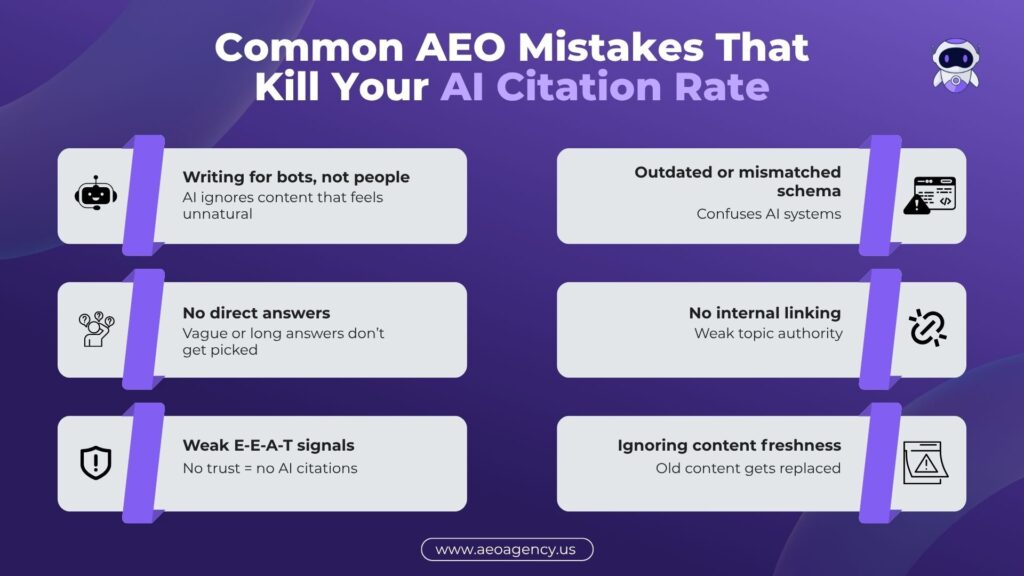
After working through all these steps, here are the most common places things go wrong:
Writing for search bots, not for people. AI tools have gotten good at spotting content that’s stuffed with keywords but doesn’t actually answer a question well. If your page reads like it was written to game an algorithm, it probably won’t be trusted enough to cite. Write for a real human first.
Skipping the direct answer. This is the most common issue. People add FAQ schema but then the answer in the schema is vague or too long. Keep schema answers under 300 words. Be direct. Be specific.
Inconsistent E-E-A-T signals. E-E-A-T stands for Experience, Expertise, Authoritativeness, and Trustworthiness. AI tools learn to associate certain sites with certain topics. If your site has no author bios, no credentials, no citations to credible sources, and no track record on a topic, you’re asking an AI to trust you with no reason to. Fix this by adding author pages, citing real sources, and keeping your content accurate and updated.
Treating a schema as a one-time task. Your content changes. When it does, your schema needs to change too. A schema answer that contradicts the on-page content creates confusion and erodes trust.
No internal linking structure. A single well-optimized page on a topic usually isn’t enough. Build the supporting cluster and connect everything together.
Ignoring freshness. AI tools, especially Google’s, factor in content freshness. A page that hasn’t been touched in three years is a weaker AEO candidate than one updated in the last six months. Build a habit of reviewing and refreshing your key AEO pages at least twice a year.
Need help turning your existing content into AI-friendly answers? Get in touch with AEO Agency and start building a smarter AEO strategy.
Published by AEO Agency | aeoagency.us