
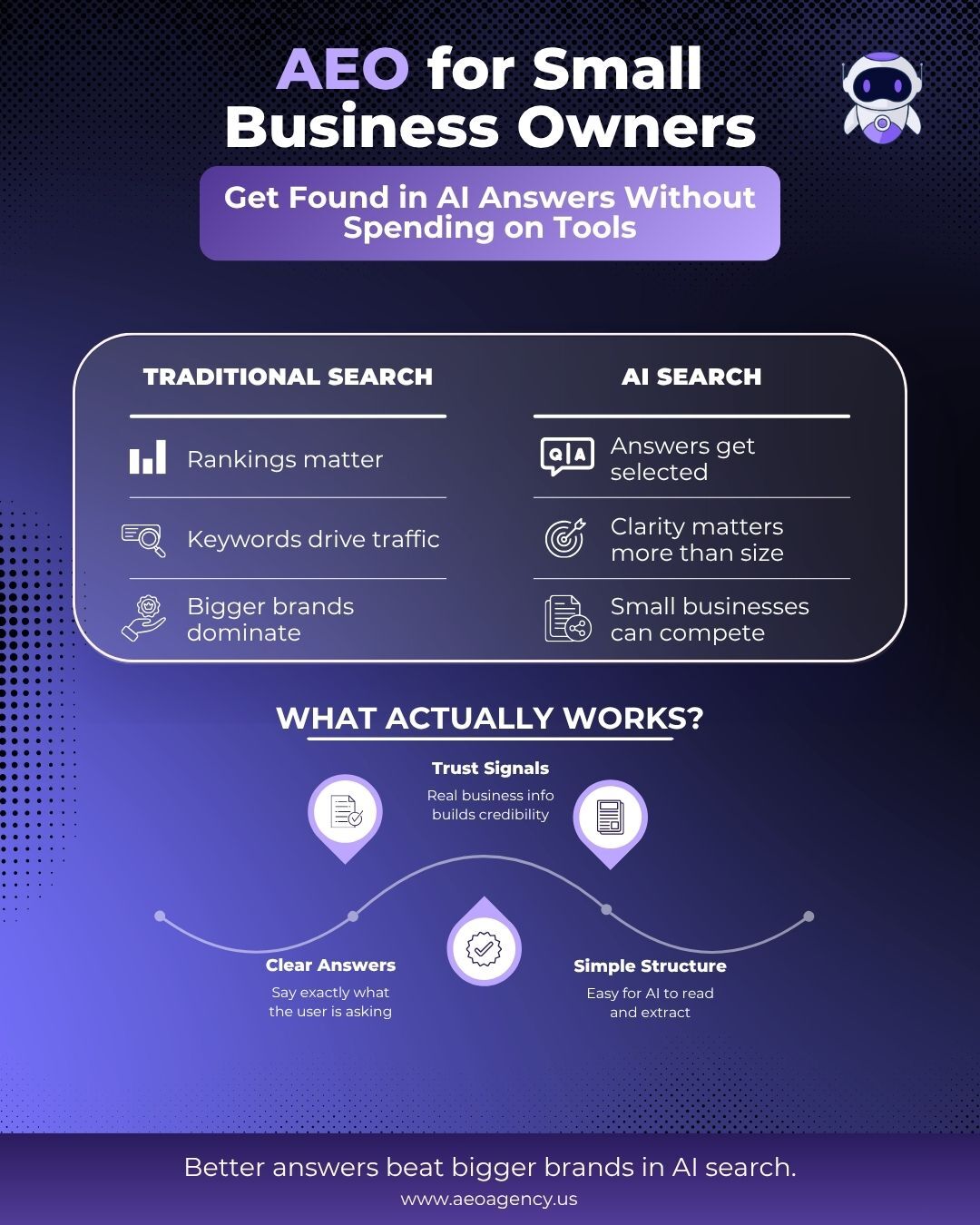
Here’s something most marketing agencies won’t tell you: small businesses are not at a disadvantage when it comes to AI search optimization. In some ways, they’re in a better position than big brands.
Large companies have sprawling websites with thousands of pages, inconsistent messaging across departments, and content written by committees. Small businesses can be specific, clear, and consistent in a way that bigger sites struggle to match. And that’s exactly what AI tools look for when they decide who to cite.
This article is for the business owner who doesn’t have a marketing team, doesn’t want to spend money on expensive tools, and just wants to know, “What do I actually do?
Let’s go through it.
Why Small Businesses Are in a Stronger Position for AI Search Than You Think
AI engines like ChatGPT, Perplexity, and Google AI Overviews don’t rank the biggest websites. They cite the most useful, credible, specific answer.
That’s a meaningful distinction. A local accountant who has written a clear, accurate, question-and-answer-style page about “What documents do I need for a self-employed tax return?” has a real chance of being cited by an AI even against a national accounting firm if their answer is better formatted, more specific, and more trustworthy.
Big brands have the advantage of domain authority, backlink profiles, and existing reputation. But in AI search, those things help but don’t guarantee anything. What actually moves the needle is whether your content answers questions clearly and whether your website gives AI tools enough signals to trust you.
The things AI tools look for most—a real author, specific answers, accurate information, and consistent name and address details for local businesses—are things a solo operator can absolutely nail.
You don’t need 500 blog posts. You don’t need a PR team. You need a small number of very well-structured, genuinely useful pages.
The Three Things AI Engines Look for Before They Cite Anyone (Even a Small Business)
If you want to appear in AI-generated answers, your content needs to clear three basic bars. Get these right and you’re already ahead of most small business websites.
1. A clear, direct answer to a specific question
AI tools are built to answer questions. They look for content that does the same. If someone asks ChatGPT “what should I look for in a plumber in Denver,” it’s going to find pages that directly answer that kind of question, not pages that just list services.
Your content needs to answer questions out loud. Not just imply answers, but state them plainly. “The most important things to look for in a plumber are a valid license, liability insurance, and a clear written estimate before any work begins.” That’s a quotable answer. “We are a full-service plumbing company with years of experience” is not.
2. Trust signals that a machine can verify
AI tools can’t visit your office or call your references. They look for signals in your content and on the web that suggest you’re a real, credible business. These include:
- A consistent business name, address, and phone number across your website, Google Business Profile, and any directories you’re listed in
- Author information (even a basic bio saying who wrote the content and what their background is)
- Links from other credible websites to yours
- A secure website (HTTPS, not HTTP)
None of these cost money. They just require attention.
3. Content structured so a machine can read it
Even if you have great information, if it’s buried in a wall of text with no headings, no clear Q&A structure, and no formatting, AI tools will struggle to extract it. Structure matters.
Use clear headings. Break content into sections. Use short paragraphs. And for questions you’re trying to answer, state the answer in the first sentence of that section.
What You Can Fix on Your Website This Week for Free (No Tools Required)
These are changes that cost nothing but time and genuinely move the needle for AI search visibility.
Rewrite your homepage headline to be specific
Most small business homepages say something like “Professional Services You Can Trust” or “Serving [City] Since 2005.” These are meaningless to an AI tool. Replace your headline with something that tells a machine exactly what you do, for whom, and where.
“We help Denver homeowners fix plumbing problems fast, with upfront pricing and same-day availability” is something an AI can work with. It answers the implicit question, “Who is this business and what do they do?”
Add a simple Q&A section to your most important service pages
Pick your three most-visited service pages. On each one, add a section called “Common Questions About [Service]” and answer 4 to 6 questions that your actual customers ask. Write the questions in the natural way a customer would phrase them, and answer each one in 2 to 3 sentences.
You don’t need schema markup for this to help (though adding it later will help more). Just having clearly formatted Q&A blocks on your page gives AI tools something to grab.
Update your “About” page to include specific credentials
If your About page says “we’re passionate about helping our clients,” it’s doing nothing for you in AI search. Update it to include:
- Your real name and background
- Any licenses, certifications, or years of experience that are relevant
- The specific types of customers or problems you work with
- Where you’re located and what area you serve
This is basic trust-building, and it’s free.
Fix your NAP consistency (Name, Address, Phone)
If your business name appears as “Smith Plumbing” on your website, “Smith Plumbing LLC” on Google, and “Smith’s Plumbing Co.” on Yelp, that inconsistency can undermine your credibility in AI systems that are trying to verify you’re a real, established business. Pick one exact version of your business name and make sure it’s the same everywhere.
How to Write an FAQ Section That AI Actually Uses (AEO FAQ Writing for Small Business)
A well-written FAQ section is the single highest-return content investment a small business can make for AI search. Here’s how to write one that actually gets picked up.
Use real questions, not marketing questions
Bad: “Why choose Smith Plumbing for your home repair needs?” Good: “How much does it cost to fix a leaking pipe in Denver?”
The first one is a sales question. The second is what an actual person types into an AI tool. Write the questions your real customers ask in the words they actually use.
Answer directly and completely in 2 to 4 sentences
Each answer should be self-contained. An AI tool might extract just that answer without the surrounding context, so it needs to make sense on its own. Don’t start with “Great question!” or “It depends.” Start with the actual answer.
“A basic pipe leak repair in Denver typically costs between $150 and $400, depending on the pipe location and the extent of the damage. Emergency repairs outside business hours usually add a call-out fee of $75 to $150.”
That answer is specific, factual, locally relevant, and citable.
Stick to questions your business can answer with real authority
Don’t write FAQ questions about things you’re vague on. AI tools are getting better at detecting hedging and uncertainty in text. Write about what you genuinely know well, and be specific.
Add at least 6 to 8 questions per FAQ section
One or two questions aren’t enough to signal depth. Aim for 6 to 8 well-answered questions on each key service page. You can also have a dedicated FAQ page for your business as a whole, covering questions like hours, service area, how to book, what to expect on a first visit, and pricing structure.
Google Business Profile Updates That Help with AI Overview Visibility (Local AEO for Small Business)
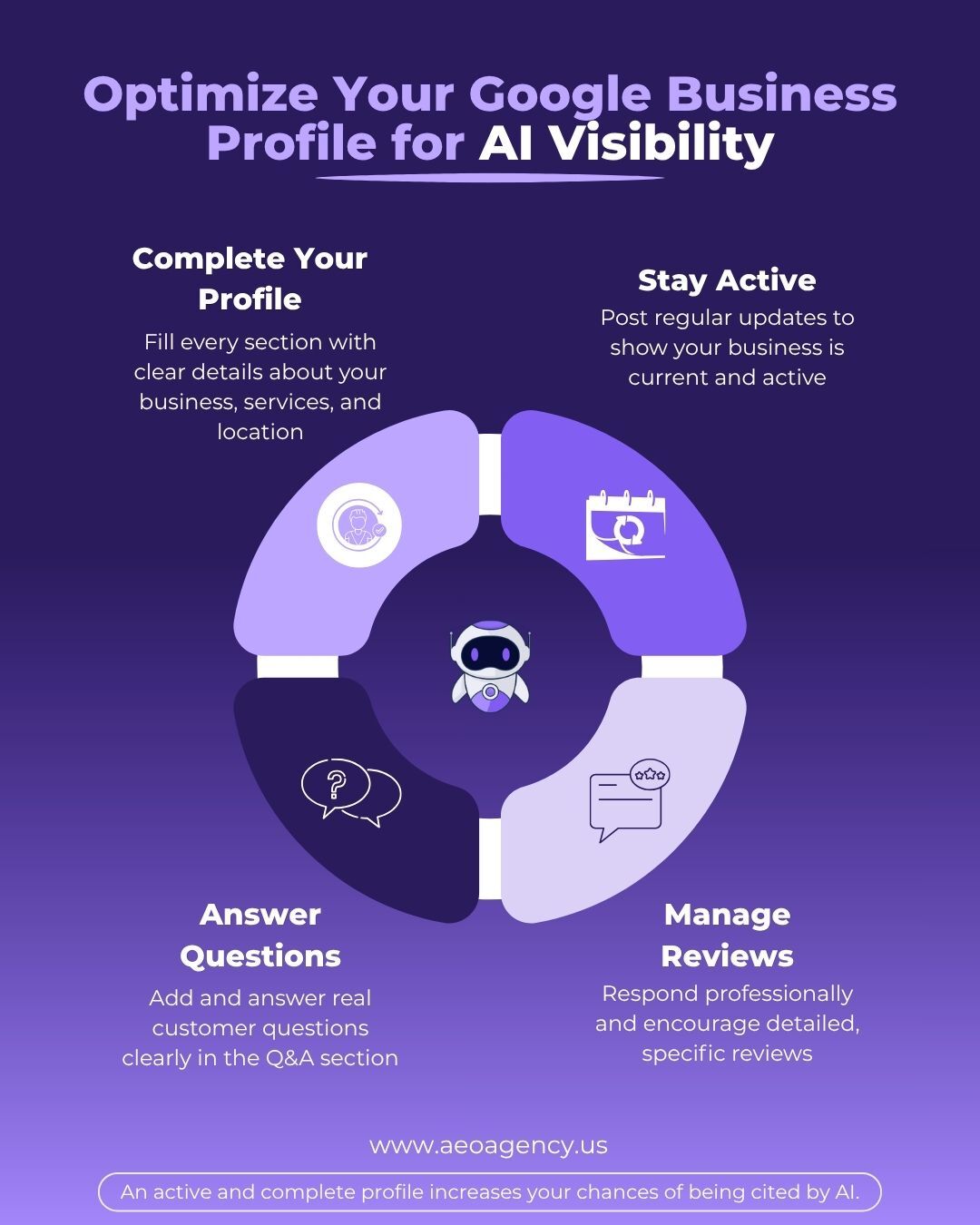
Your Google Business Profile (GBP) is one of the most direct levers a local small business has for appearing in AI search, and most small businesses are using it at about 30% of its potential.
Here’s what to do:
Fill out every section completely
Business category, description, services, products, attributes—all of it. The more complete your profile, the more data AI has to work with when deciding whether to reference you. The business description in particular is valuable: write 2 to 3 sentences that clearly state what you do, who you help, and where you’re located.
Post updates weekly or, at minimum, monthly
Google Business Profile posts are a signal of an active, legitimate business. AI Overviews pull from active, up-to-date sources. Posting regularly, even short updates like seasonal specials, helpful tips, or changes to your profile, keeps it fresh in Google’s eyes.
Answer questions in the Q&A section directly
The Q&A section on your GBP is often ignored, but it’s a direct AEO opportunity. Go in and add questions yourself (using real customer questions) and answer them. Google’s AI systems read this content. Give clear, specific answers.
Respond to reviews and ask for specific ones
When customers leave reviews, respond to them professionally. When asking for reviews, encourage customers to be specific (“mention what service you had done and where” rather than just asking for “a nice review”). Reviews that mention your services and location add credibility and specific keyword signals.
When Does It Make Sense to Hire an AEO Agency and What Should You Expect?
Doing AEO yourself is absolutely possible for a small business, especially in the early stages. But there comes a point where professional help makes sense.
You might be ready to hire an AEO agency when:
- You’ve done the basics and are seeing some results but want to move faster
- Your business operates in a competitive market with multiple local rivals
- You want to go after higher-volume, more competitive AI search queries
- You don’t have time to keep up with content updates and schema maintenance
- You want someone to build out a full content cluster strategy, not just fix a few pages
What should you expect from a legitimate AEO agency?
They should start by auditing where you currently stand, which prompts you to appear in, which you don’t, and what your biggest content and technical gaps are. They should give you a clear roadmap with milestones, not just a vague promise to “improve your AI visibility.”
Be cautious of anyone who promises overnight results. AEO is not a one-week fix. A good agency will set realistic timelines (3 to 6 months for meaningful traction) and show you how they’ll measure progress.
Ask specifically: How will you track whether my content is being cited by AI tools? How often will I get reporting? What does a typical month of work look like? The answers tell you a lot.
Start optimizing your small business for AI search today—your competitors won’t know what hit them.
Contact AEO Agency USA Today!
Published by AEO Agency | aeoagency.us