
If you’ve spent any time in marketing circles recently, you’ve probably seen all three of these acronyms floating around, sometimes used interchangeably, sometimes argued about at length. SEO, you’ve known for years. AEO and GEO (generative engine optimization) are newer, and there’s a lot of confusion about whether they replace SEO, overlap with it, or do something completely different.
They’re related. But they’re not the same thing. And choosing the wrong one to focus on for your specific situation means wasted resources and missed opportunities.
This article breaks down exactly what each one is, what makes them different, and how to decide which one deserves your attention first. No hype, no vague advice, just a clear framework you can actually use.
Why AEO, SEO, and GEO Got Confused in the First Place
The short answer: They all live in the same general neighborhood of “getting found online,” and the lines between them have blurred as AI has changed what search looks like.
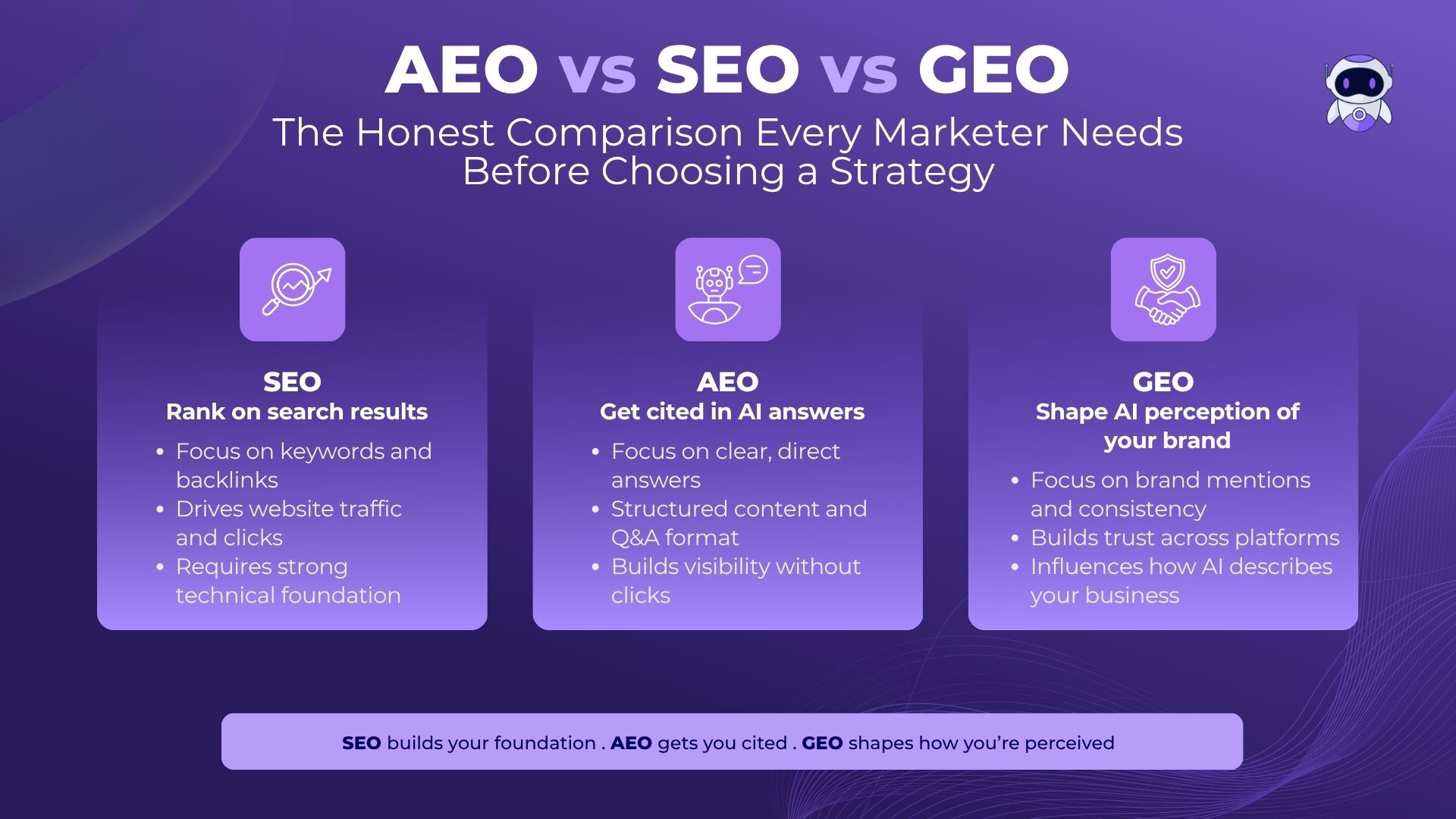
SEO, Search Engine Optimization, is the original. It’s been around since the 1990s, and it’s about getting your pages to rank on search engines like Google. Most marketers understand this one.
AEO (Answer Engine Optimization) emerged as a distinct discipline when AI tools like ChatGPT, Perplexity, and Google’s AI Overviews started generating direct answers to queries rather than just returning a list of links. AEO is about getting your content cited within those AI-generated answers.
GEO, Generative Engine Optimization, is sometimes used as a broader umbrella term for optimizing across all AI-driven search and generation systems, but in practice, many people use it to describe something slightly different: shaping how AI systems describe and represent your brand as a whole, not just whether they cite your content.
The confusion happens because:
- All three involve content, technical website health, and credibility signals
- Some tactics help with all three simultaneously
- Different agencies and writers use the terms differently
By the end of this article, you’ll have a clear enough picture to make your own call.
SEO Is Still the Foundation That Everything Else Builds On
Let’s be direct: SEO is not dead. Anyone telling you to abandon it in favor of AEO or GEO is either misinformed or selling something.
Here’s why: the same infrastructure that makes your site rank on Google (indexed pages, backlinks, domain authority, page speed, mobile usability, and well-organized content) also makes your site more likely to be trusted and cited by AI tools. There is no AEO without a foundation of decent SEO.
What SEO focuses on:
- Keyword research and matching content to search intent
- Technical health (page speed, crawlability, Core Web Vitals)
- Backlink building to establish authority
- On-page elements like title tags, meta descriptions, and heading structure
- Content depth and relevance
What SEO is optimizing toward: a position on a search results page that generates clicks to your website.
What SEO doesn’t address: the growing percentage of searches that never result in a click because the AI gives the answer directly on the results page. This is where AEO matters.
SEO is still responsible for the majority of organic traffic for most websites. The channels haven’t flipped yet, though AI-driven searches are growing fast. If you neglect SEO entirely in favor of AEO, you’ll be chasing AI citations while your organic traffic baseline erodes.
AEO: Optimizing to Be the Answer, Not Just a Link in the Results
AEO is specifically about getting your content used as the source material for AI-generated answers. When someone asks ChatGPT or Perplexity a question and the AI responds with information, some of that information came from somewhere. AEO is about making sure some of it comes from you.
What AEO focuses on:
- Writing content that directly answers specific questions
- Structuring pages with answer-first formatting and clear headings
- Adding schema markup (FAQ, HowTo, Article) so AI tools can parse your content
- Building topical authority through clusters of interconnected content
- Monitoring AI citations and adjusting based on what’s working
What AEO is optimizing toward: being cited as a source in AI-generated answers across tools like Google AI Overviews, Perplexity, ChatGPT, and similar platforms.
What AEO doesn’t address: your broader brand reputation in AI systems, your rankings on traditional search results pages, or your general web authority.
One important point about AEO: it tends to favor content that is specific, well-structured, and factually accurate over content that is broad and keyword-heavy. This actually makes AEO a useful discipline for improving content quality overall. Pages that perform well for AEO tend to be better pages for readers too.
GEO: Managing How AI Builds a Picture of Your Brand
GEO is the newest of the three and also the least standardized in terms of how people define it.
In the way most practitioners use it, GEO is about how AI systems represent your brand when someone asks about it. Not just “Does AI cite my website?” but “What does AI say about my company when someone asks who we are, what we do, and whether we’re trustworthy?”
When someone types “who is the best AEO agency for small businesses” into Perplexity, what does the AI say? Does your brand come up? How is it described? Is the information accurate? This is GEO territory.
What GEO focuses on:
- Ensuring your brand is represented accurately across AI-indexed content (your site, press coverage, directories, social profiles)
- Building up a web of mentions and citations that reinforce consistent brand positioning
- Monitoring what AI tools say about you across multiple prompts
- Managing your digital reputation in AI-readable formats
What GEO is optimizing toward: the way AI systems describe, position, and recommend your brand, not just whether they cite specific pages.
What GEO doesn’t address: individual page rankings, specific content citations, or technical website issues.
Think of GEO as reputation management for the AI era. It cares less about whether your FAQ page shows up in an AI answer and more about whether your business is presented accurately and favorably when AI is asked to recommend or describe companies like yours.
Side-by-Side Comparison: AEO vs SEO vs GEO Goals, Tactics, and Measurement
| SEO | AEO | GEO | |
| Primary goal | Rank on search results pages | Get cited in AI-generated answers | Shape how AI represents your brand |
| Measures success by | Rankings, organic traffic, click-through rates | AI citation frequency, AI Overview appearances | Brand mentions in AI responses, accuracy of AI descriptions |
| Key tactics | Keywords, backlinks, technical site health | Answer-first content, schema markup, topical clusters | Consistent brand presence across AI-indexed sources |
| Best for | Driving website traffic | Capturing no-click AI search visibility | Brand positioning and reputation in AI systems |
| Timeline to results | 3 to 6 months typically | 6 to 12 weeks for initial citations | Ongoing, tied to brand reputation cycles |
| Who does it | SEO specialists, content teams | AEO specialists, content strategists | PR, brand managers, AEO/SEO hybrids |
| Technical requirement level | Medium to high | Low to medium | Low to medium |
| Tools used | Semrush, Ahrefs, Google Search Console | Perplexity, SE Ranking, manual testing | Brand24, Mention, Perplexity, manual prompting |
The overlap column not shown here is substantial: all three benefit from high-quality, well-structured, trustworthy content on a technically sound website. Improving your content for AEO will generally also help your SEO. Building your brand reputation for GEO will also make you more likely to be cited for AEO purposes.
Which One Should You Start With? A Decision Framework Based on Your Situation
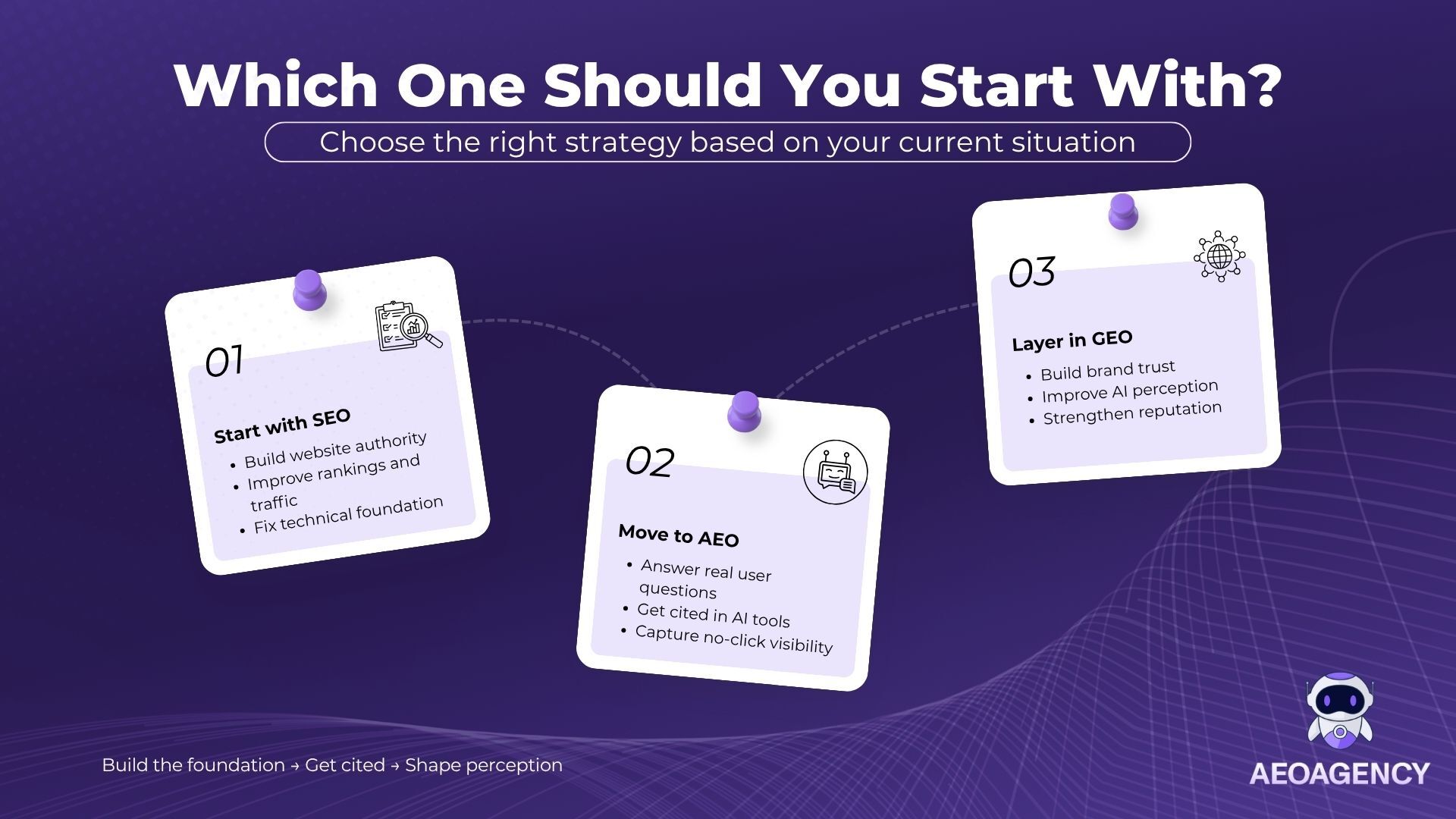
There’s no universal right answer, but here’s a clear decision framework based on the most common situations:
Start with SEO if:
- Your website is new or has very low domain authority
- You’re getting minimal organic traffic right now
- You haven’t done keyword research or on-page optimization yet
- You have no backlinks to speak of
You need the foundation before the advanced work makes sense. AEO and GEO are harder to execute on a site that isn’t yet trusted by search engines.
Move to AEO next (or alongside SEO) if:
- Your site has reasonable domain authority and existing organic traffic
- Your target audience is actively using AI tools to research before buying
- You’re in a question-heavy niche (legal, medical, financial, home services, tech, marketing)
- You’ve noticed your click-through rates dropping even for queries you rank for (a sign that AI Overviews may be answering queries before users click)
- You want to capture visibility in AI tools like ChatGPT and Perplexity
Layer in GEO if:
- You’re in a category where brand trust drives purchase decisions
- You want to make sure AI tools describe your company accurately when asked
- You’ve started getting cited for AEO and now want to shape the broader brand narrative in AI responses
- You’re managing reputation after negative coverage or a difficult period
Run all three simultaneously if:
- You have the team or budget to do so
- You’re in a competitive space where your rivals are already doing this
- Your sales cycle involves multiple touchpoints and you want to be present at all of them
The honest reality is that most serious brands in 2026 need all three. They’re not competing strategies; they’re different layers of the same goal being visible, credible, and well-represented wherever your potential customers are searching.
Why Serious Brands Are Running All Three Simultaneously in 2026
Here’s the pattern that’s emerging: the brands that are winning across all search channels are the ones that have stopped treating SEO, AEO, and GEO as separate decisions.
They’re building content that is genuinely useful, answer-specific, and technically well-marked up. That content works for SEO (it ranks), for AEO (it gets cited by AI), and for GEO (it builds the web of brand mentions that AI systems use to understand what a company does and whether it’s trustworthy).
The common thread across all three is: be genuinely good at what you do, communicate it clearly, and structure your web presence in a way that machines can verify.
That’s not a hack. It’s not a temporary trend. It’s just a solid communication strategy adapted for how people now find information, which increasingly involves asking a machine a direct question and expecting a direct answer.
The businesses that are most at risk are the ones doing only one of these three and ignoring the others. Heavy SEO without AEO leaves you ranking for queries where AI is answering before anyone clicks. Heavy AEO without SEO means you’re optimizing pages that don’t have enough authority to be taken seriously by AI tools anyway. GEO without either means you’re focused on brand perception while ignoring the pages that actually need to perform.
Build the foundation, add the citation layer, and shape the brand narrative. That’s the sequence that makes sense in 2026.
Ready to choose the right strategy for your business? Start optimizing today and stay ahead in 2026.
Contact AEO Agency USA Today!
Published by AEO Agency | aeoagency.us