

Search does not work the way it used to.
People still open Google, but many now start with ChatGPT. Others rely on Gemini inside Google results. Some never even see a traditional list of blue links. They ask a question and expect a direct answer.
That shift changes how content gets discovered, cited, and recommended.
This guide explains how AI-optimized content works in 2026, why older SEO methods fall short, and how to create pages that Google, ChatGPT, and Gemini can confidently reference. Not with tricks or shortcuts, but with clarity, structure, and trust.
If you publish content for real people and also want AI systems to surface it, this is the framework that actually holds up.
Why AI Search Changed Content Ranking Forever
Traditional search focused on matching keywords to pages. AI search focuses on matching questions to answers.
Large language models read content differently. They do not scan for density or exact phrasing. They look for meaning, clarity, relationships between ideas, and whether the information feels reliable enough to repeat.
That is why AI SEO optimization now centers on how content explains things, not how often it repeats them.
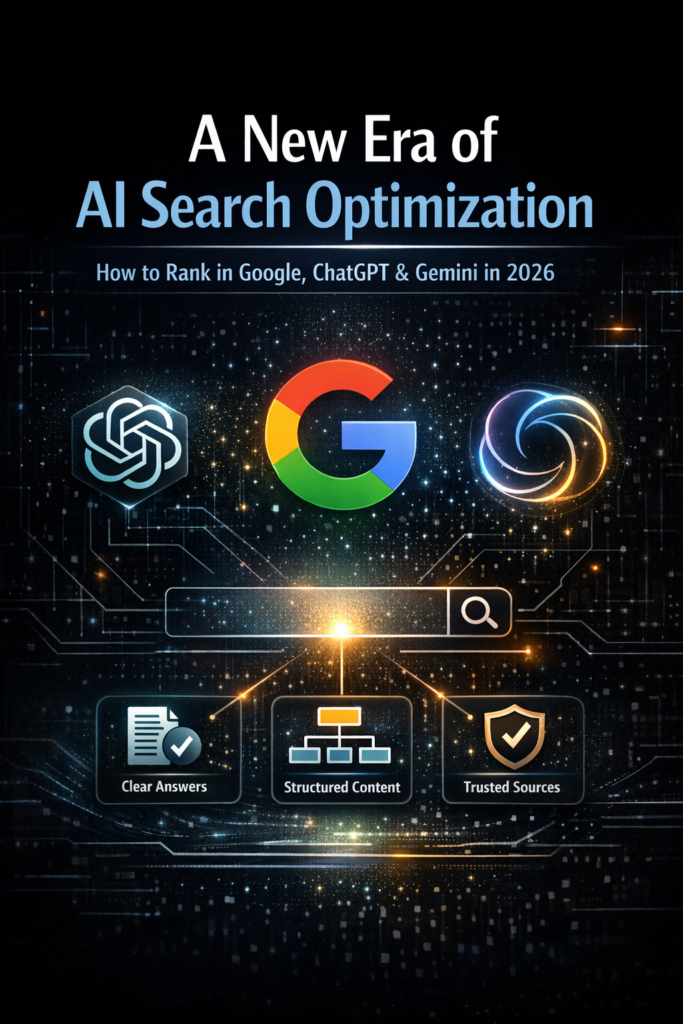
This is the heart of Answer Engine Optimization (AEO). Instead of ranking a page, AI systems choose sources to speak on their behalf.
If your content sounds unsure, thin, or stitched together for traffic, it rarely gets picked.
If it sounds like a calm expert explaining something clearly, it has a much better chance.
How AI Systems Read and Evaluate Content
AI models do not browse pages like humans. They break content into ideas and facts, then connect those ideas to known topics and sources.
A few things stand out.
They prefer content that answers one question fully instead of touching ten topics lightly.
They favor pages where sections logically follow each other, without sudden jumps.
They rely on internal consistency. If a page contradicts itself or feels stitched together, trust drops fast.
This is why SEO for AI search engines looks less like keyword placement and more like clear teaching.
When content reads like it was written by someone who understands the subject, AI models are more willing to reuse it.
How AI Changes Google Search Results
Google still crawls and indexes pages the same way. The change happens after that.
With AI Overviews and generative answers, Google now summarizes content directly in search results. Only a small set of sources gets cited.
Those sources usually share a few traits.
They explain concepts plainly.
They cover the topic from start to finish.
They avoid hype and vague language.
They feel written for people, not algorithms.
This is where how AI changes Google search becomes very real for site owners. Ranking number one matters less if Google answers the question before users click.
Content now needs to earn visibility by being quotable.
The Role of AI-Driven SEO Strategy
An AI-driven SEO strategy starts with intent, not keywords.
Ask simple questions.
What problem is the user trying to solve?
What follow-up questions will they have?
What would a clear answer sound like if you were explaining this out loud?
When content flows the way a conversation would, AI systems can extract answers cleanly. That makes it useful in AI summaries, chat responses, and recommendation blocks.
This approach also aligns with the future of SEO in the AI era, where authority comes from clarity, not scale.
Writing Content AI Can Understand and Trust
AI does not need fancy language. It needs a clean structure.
Start with a clear introduction that states what the page covers.
Use headings that describe exactly what the section explains.
Keep paragraphs short and focused.
Avoid stuffing multiple ideas into one block of text.
This is the foundation of writing content AI can understand. When each section answers a specific question, models can reuse those answers confidently.
A simple test helps. Read a paragraph and ask yourself if it answers one clear question. If not, it needs tightening.
Semantic Content and Entity Relationships
AI systems rely on entities. These are people, places, concepts, and services that exist independently.
For example, Google, ChatGPT, Gemini, and AI search are all separate entities. Content that explains how they relate shows stronger understanding.
This is where semantic content optimization and entity-based SEO content come into play.
Instead of repeating phrases, explain relationships.
Explain how Google differs from ChatGPT.
Explain how Gemini connects to Google Search.
Explain where AI summaries pull from.
This context helps AI models place your content correctly.
Building Topical Authority Without Sounding Forced
Topical authority does not come from publishing hundreds of posts. It comes from covering a subject thoroughly and consistently.
A strong topical authority content strategy includes:
One core guide that explains the topic fully.
Supporting articles that answer related questions.
Clear internal links that connect ideas naturally.
When AI systems see consistent depth across related pages, trust increases. That is how sites become recurring sources in AI responses.
Ranking Content in Google AI Search
Ranking in Google AI results depends on how useful your content is when summarized.
Pages that get cited usually:
Answer common questions directly.
Avoid long introductions that delay answers.
Use simple language that sounds confident but not absolute.
Strategies for ranking content in Google AI search are less about position and more about usefulness.
If Google can quote your page without editing it, that is a strong signal.
How ChatGPT Chooses Which Sites to Recommend
ChatGPT does not rank pages the same way Google does. It selects sources that help it answer clearly.
It favors content that:
Explains concepts step by step.
Uses examples where helpful.
Avoids marketing language.
Feels steady and factual.
This is the core of how ChatGPT recommends websites. The model wants to reduce risk. Clear explanations lower that risk.
How Gemini Ranks and References Content
Gemini sits closer to Google’s index and knowledge graph. It blends traditional search signals with AI understanding.
Pages that perform well for ranking in Gemini content often show:
Clear authorship or brand ownership.
Structured headings.
Consistent internal linking.
Supporting context across the site.
Gemini relies heavily on how information connects across pages, not just within one article.
Structured Data and Technical Clarity
Structured data helps AI systems understand what a page represents.
Schema does not guarantee visibility, but it reduces confusion.
Use it to mark articles, FAQs, organizations, and services.
This supports structured data for AI search and schema optimization for AI engines without forcing anything unnatural.
A clean site structure also matters. Pages should be easy to crawl and logically grouped. This supports AI-friendly website architecture and technical SEO for AI indexing.
Trust Signals That AI Systems Pay Attention To
AI models evaluate trust differently than humans.
They look for consistency across the site.
They compare claims against known sources.
They notice when content avoids exaggeration.
This is why E-E-A-T optimization for AI search focuses on tone as much as credentials.
Clear explanations build trust faster than bold claims.
So does acknowledging limits. If something is uncertain, say so or leave it out.
Local Signals Without Forcing Location Terms
AI systems infer location from context.
Service descriptions.
Local examples.
Internal links to service pages.
Mentions of regions you serve.
This helps with building topical authority for AI while supporting local discovery.
You do not need to repeat city names awkwardly. AI understands relevance through patterns.
Why Old SEO Tactics Fall Short
Older SEO often relied on volume and repetition.
AI systems do not reward that.
Thin pages, keyword swaps, and surface-level rewrites rarely get cited.
This explains why traditional SEO no longer works the way it once did.
AI prefers fewer, better sources.
How AI Chooses Which Sites to Reference
AI models favor sources that feel safe to quote.
That usually means:
Clear structure.
Plain explanations.
No exaggerated promises.
A steady, neutral tone.
This answers how AI chooses which sites to recommend. It is about reliability, not hype.
Turning AI Visibility Into Real Business Value
Visibility matters only if it leads to trust.
When people see your brand mentioned in AI answers, they often search for you later. They visit your site with higher intent.
This is where AI search optimization services and AI search visibility services make a real difference.
Clear content builds recognition before a user ever clicks.
For businesses that want long-term traction, working with an experienced AI SEO agency or Answer Engine Optimization agency can help connect content strategy with measurable growth.
AEO Agency focuses on this balance between clarity, trust, and discovery, without turning content into sales copy.
Final Thoughts on Creating AI-Optimized Content
AI search rewards content that respects the reader.
Explain things clearly.
Answer real questions.
Structure pages so ideas flow naturally.
Avoid shortcuts.
When content feels written by someone who understands the topic and wants to help, AI systems notice.
That is how pages earn citations, recommendations, and lasting visibility across Google, ChatGPT, and Gemini.